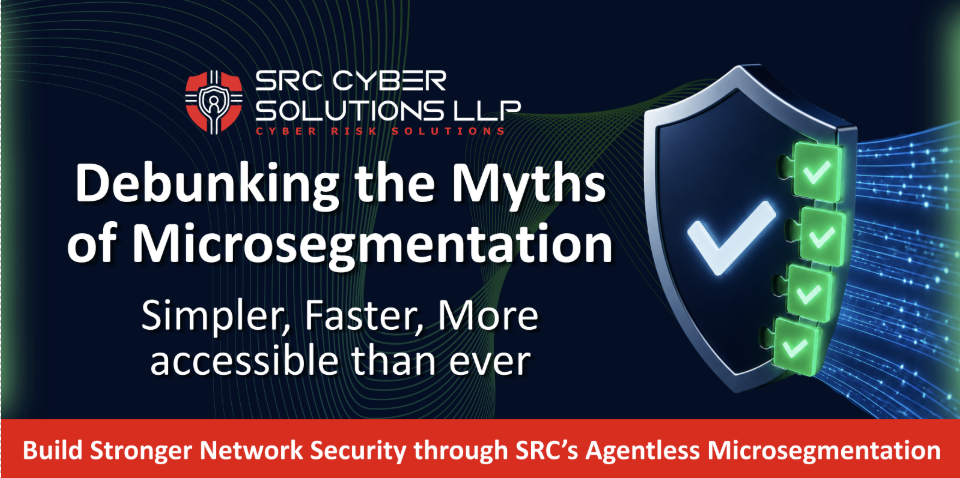
As cyberattacks become more sophisticated, organizations are increasingly adopting microsegmentation to reduce lateral movement and strengthen their Zero Trust strategies. Yet, despite its growing importance, several misconceptions continue to prevent businesses from realizing its full potential.
Let's separate fact from fiction.
Myth 1: "We Are Already Microsegmented."
Many organizations believe that implementing VLANs, firewalls, or network zones is the same as microsegmentation. In reality, these technologies provide broad network segmentation but often fail to enforce granular, identity-based controls between workloads and systems.
True microsegmentation limits communication at the workload level, ensuring that only authorized users, applications, and devices can communicate. Without these controls, attackers can still move laterally across the network once they gain an initial foothold.
Myth 2: "Microsegmentation Is Too Complex and Time-Consuming."
Traditional microsegmentation projects often required lengthy deployments, complex rule creation, and extensive network redesign. That perception still exists today.
However, modern agentless microsegmentation has transformed the deployment process. With automated policy recommendations, identity-based controls, and minimal infrastructure changes, organizations can significantly reduce deployment time while simplifying ongoing management.
Myth 3: "Our EDR Solution Is Enough."
Endpoint Detection and Response (EDR) solutions play a critical role in identifying suspicious activity and responding to threats. However, detection alone does not stop an attacker from moving laterally after an endpoint has been compromised.
Microsegmentation complements EDR by enforcing least-privilege access and containing threats before they spread across the environment. Even if one system is compromised, the attacker cannot freely access other critical assets.
Why Microsegmentation Matters
Modern cyberattacks rarely stop at the first compromised device. Their objective is to move laterally, escalate privileges, and reach high-value systems.
Microsegmentation reduces this attack surface by restricting unnecessary communication between users, applications, workloads, and devices. Combined with a Zero Trust strategy, it helps organizations improve resilience, minimize business disruption, and strengthen overall security posture.
SRC Agentless Microsegmentation for Smarter Network Security
SRC offers an Agentless Microsegmentation Platform that enables organizations to implement granular network segmentation without installing agents on endpoints. By leveraging AI/ML-driven automation, SRC helps automate asset discovery, tagging, policy creation, and least-privilege access controls, making segmentation easier to deploy and manage across large and complex environments. It provides greater control over east-west traffic, helping security teams restrict unauthorized communication, reduce lateral movement, and contain potential threats. This approach strengthens Zero Trust while reducing the operational complexity and overhead associated with traditional microsegmentation solutions.